

Every application season, thousands of ambitious students sit down to write their Statement of Purpose (SOP).
They open Google Docs, MS Word, or Pages. They look at their resumes. They search for sample SOPs from admitted students. Some open ChatGPT or Claude and type: “Write me a compelling Statement of Purpose for Cornell/Stanford/MIT.”
An hour later, they have 1,000 beautifully formatted words.
There is just one problem.
The document sounds convincing, but the thinking behind it is missing.
In 2026, when AI can generate grammatically polished essays in seconds, the real differentiator isn’t how beautifully you write. It’s how intelligently you connect your experiences, intellectual interests, career aspirations, and the university you’re applying to.
After an extensive brainstorming session with a graduate applicant preparing for Cornell Tech’s MS application, I was reminded of something fundamental:
The best SOPs aren’t written. They’re discovered!
Here is a framework to approach yours differently.
1. Before writing your SOP, learn to think beyond your resume
Let’s start with a common misconception.
Your SOP is not your resume rewritten in paragraphs.
Your resume
- Tells the admissions committee what you have done
Your SOP
Must explain
- Why those experiences matter
- What they taught you
- How they shaped your interests
- Where you intend to take them next
Consider an applicant who has worked across product management, marketing, IoT software engineering, website development, data science, and AI automation.
At first glance, this might appear to be an applicant who cannot make up their mind.
But what if these experiences represent something else?
Perhaps the applicant deliberately explored different disciplines to understand the intersection of technology, business, mathematics, and product development.
Perhaps each experience helped eliminate certain career possibilities while bringing a larger intellectual interest into focus.
Suddenly, what appeared to be a scattered career history becomes a story of exploration and intellectual maturity.
This is what we mean by celebrating versatility rather than apologising for it.
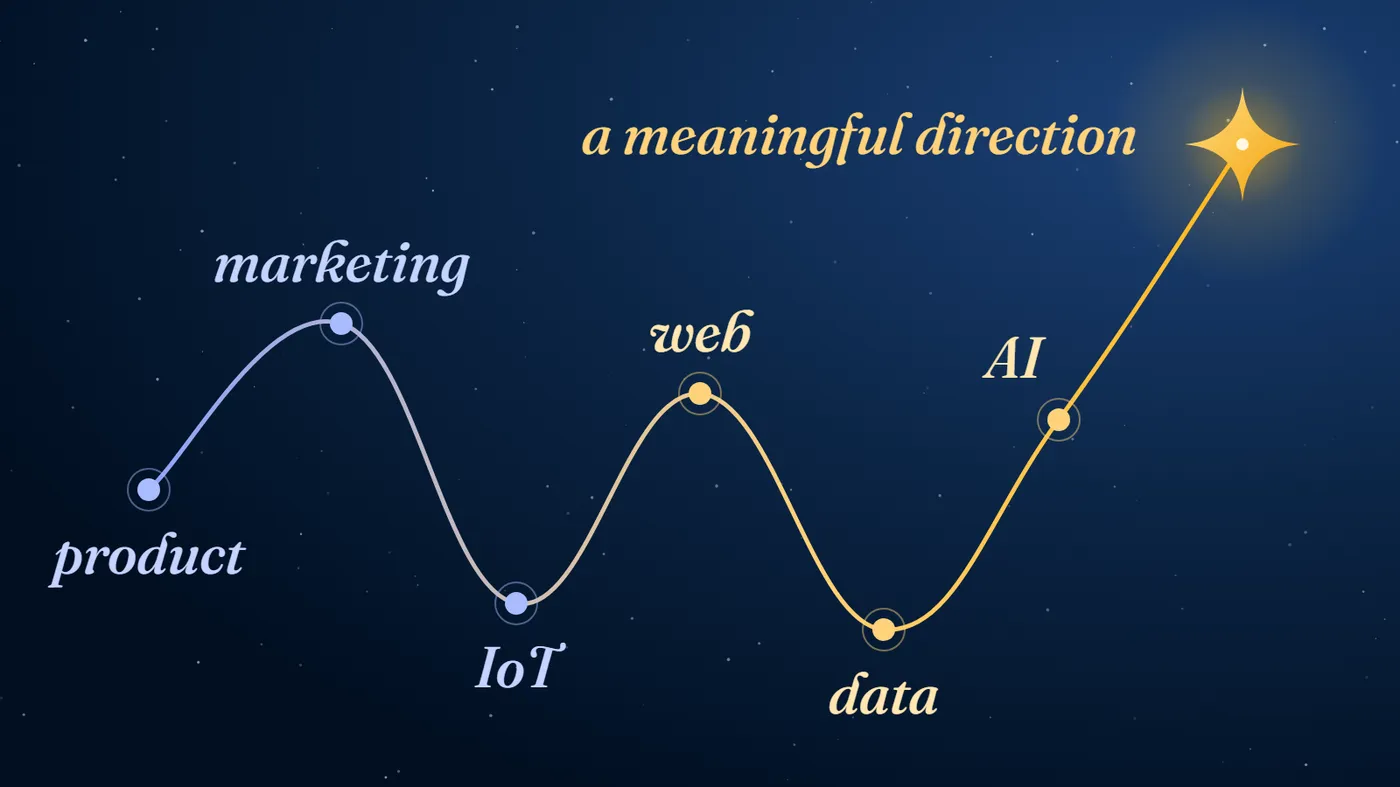
The million dollar question is not: What have you done? It’s: What have your experiences progressively taught you to pursue?
2. Find your intellectual identity before finding your opening line
Most SOP guides will tell you to begin with a compelling hook.
I would suggest something different.
Don’t begin by searching for a hook. Begin by searching for an idea.
A hook is merely the literary instrument that captures the reader’s attention. The idea behind it is what gives it substance.
There are two particularly effective approaches.
Approach A: The personal discovery
Think about a project, internship, professional experience, or research assignment that changed how you understood a particular problem.
Perhaps you were developing a product and discovered that the real challenge wasn’t the technology itself, but how people interacted with it.
Perhaps a research internship exposed a limitation in an existing approach.
Perhaps a professional experience made you realise that your current technical knowledge wasn’t sufficient to solve a problem you had become deeply interested in.
These moments of discovery can make excellent openings because they belong to you.
Approach B: The intellectual provocation
You can also begin with an idea, an argument, a book, a lecture, or a researcher’s observation that genuinely challenged your thinking.
For instance, imagine an applicant interested in artificial intelligence opening with a disagreement with an argument presented in AI Snake Oil, by Sayash Kapoor and Arvind Narayanan.
An opening that respectfully challenges an established argument can capture the attention of an insider reader.
But there is a catch.
You must have actually engaged with the material. You must understand the argument, articulate your disagreement, and explain why the discussion matters to your own intellectual journey.
An intellectual hook is a high-risk, high-reward strategy. If you cannot defend it in an interview, don’t use it.
3. Use the funnel technique: Make every sentence lead somewhere
A compelling opening paragraph should not be a collection of impressive statements.
It should follow a deliberate progression.
Think of a funnel.
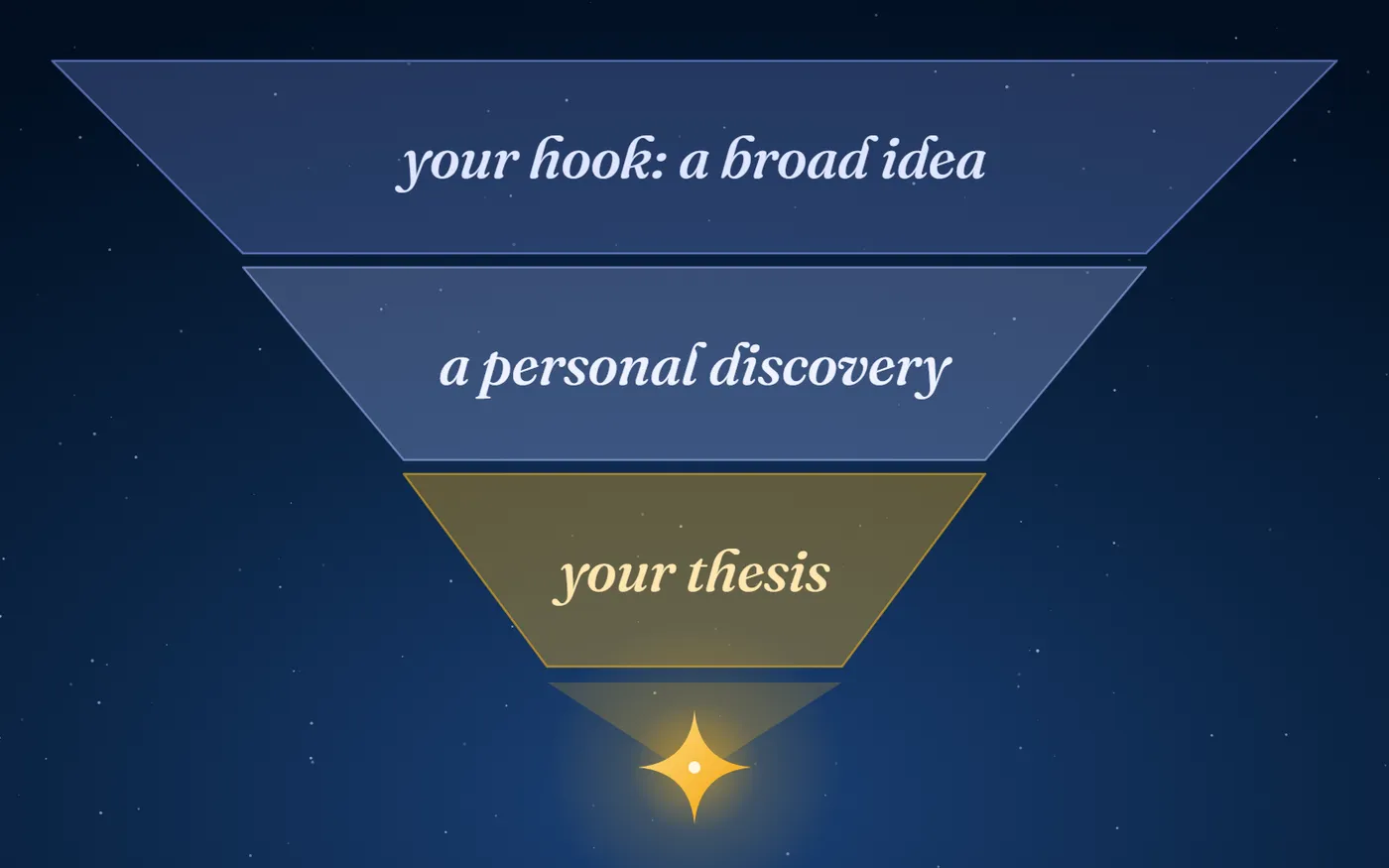
At the top, you introduce a broad idea through your hook. You then narrow the discussion through a personal observation, experience, or intellectual discovery. Finally, you arrive at a thesis statement.
The thesis statement is the last sentence of your opening paragraph and carries the weight of the entire SOP.
It should establish:
- What motivates you to pursue graduate education?
- Which discipline or specialisation are you interested in?
- Why is this the appropriate next step in your journey?
For example, an applicant interested in information science might begin with an observation about how technology has evolved from a tool for processing information into an instrument for reshaping human decisions.
The paragraph could then narrow into a personal experience that exposed the limitations of their existing understanding.
It would culminate in a clear statement explaining why graduate study in information science is the logical next step.
Notice the progression.
Hook → Broader context → Personal discovery → Thesis statement.
You have now established the intellectual premise of your SOP.
4. Build your body paragraphs around pivots, not chronology
This is where many otherwise promising SOPs lose momentum.
Applicants often reproduce their resumes chronologically:
- First, I completed my undergraduate degree.
- Then, I undertook an internship.
- Subsequently, I worked on a project.
- Later, I joined an organisation.
- Finally, I decided to pursue a master’s degree.
This is reporting, not storytelling.
Instead, identify the most relevant and impactful experiences from your academic and professional journey. Think of each as a pivot.
A pivot is an experience that advances your argument for graduate study.
You might have eight impressive experiences on your resume. Your SOP may need only four or five.
Select them based on their relevance to your intended discipline, their intellectual or professional impact, and the insight they reveal about your development.
The order should also be deliberate.
Imagine an applicant whose journey progresses through:
- Step 1 An undergraduate course that introduced an important technical concept.
- Step 2 A project that provided an opportunity to apply it.
- Step 3 A research internship that exposed a larger problem.
- Step 4 A professional experience that demonstrated the real-world implications.
- Step 5 An independent project that brought their academic interests into sharper focus.
Each paragraph should increase the reader’s understanding of the applicant’s commitment to the discipline.
Ideally, the final pivot should be more compelling than the first.
You are building momentum, not compiling achievements.
5. Give every past experience a contemporary dimension
Here is one of the most important principles in the entire strategy.
Never leave an experience trapped in the year it happened.
Suppose you completed an undergraduate project three years ago.
Simply explaining what you built and what grade you received contributes little to your present application.
Instead, reflect on what that project taught you. How has your understanding of the problem evolved? Does it connect with an emerging research interest? Has it influenced the kind of problems you want to solve today?
There are two ways to establish this contemporary dimension.
First
Connect the experience to your evolved interests.
Perhaps an undergraduate project introduced you to machine learning. At the time, your interest was primarily technical. Today, you are more interested in how machine learning can influence decision-making in healthcare. Show the progression.
Second
Connect the experience to what the university is doing today.
Perhaps your earlier project explored an idea that is now being pursued at a much larger scale at your target institution. That gives you an opportunity to demonstrate how your previous exposure prepares you to contribute to a more sophisticated academic environment.
The distinction is subtle but important.
You are no longer telling the reader what you did. You are demonstrating how your thinking has evolved because of what you did.
6. The university-fit paragraph is the heart of your SOP
Now comes the paragraph that can distinguish a university-specific SOP from a generic application essay.
Why this university?
Most students approach this question by browsing university websites and listing:
- Renowned faculty members.
- Research laboratories.
- Course offerings.
- University rankings.
- Campus facilities.
- Industry connections.
These are useful starting points, but they are rarely sufficient.
You need to understand the institution’s intellectual priorities and discover what makes its academic environment distinctive.
Consider Cornell Tech.
The important discovery wasn’t simply that these offerings existed.
It was what they collectively suggested about the learning environment.
We began viewing Cornell Tech less like a conventional university and more like a startup-oriented ecosystem built around collaboration, experimentation, and creating solutions to real-world problems.
That observation changes how an applicant should approach the SOP.
Instead of saying
“I want to study at Cornell Tech because of its excellent faculty and innovative curriculum.”
The applicant should be able to explain
- Which particular institutional philosophy resonates with their interests?
- Which academic or studio environment would help them explore those interests?
- What problem would they like to investigate or solve?
- What experiences make them prepared to participate?
- What could they contribute to the incoming cohort?
That final question is particularly important.
Why should the university want you in its classroom, studio, or student community?
Your SOP should not merely explain what you hope to receive from the institution. It should demonstrate what the institution stands to gain by admitting you.
7. Research the university beyond its website
This is where I encourage applicants to do something that many overlook.
Listen to the university’s podcasts.
Not summaries of podcasts. Not AI-generated transcripts. The actual podcasts.
During our Cornell Tech brainstorming session, I specifically recommended exploring student podcasts, the Good Code Podcast, and the Cornell Tech Bloomberg speaker series.
Why?
Because institutional websites communicate what universities want applicants to know. Research papers communicate what scholars are formally investigating.
But conversations, lectures, and podcasts can reveal something different: what people are genuinely passionate about discussing.
A professor might spend years publishing research on a particular technical subject, but in a podcast, their enthusiasm might revolve around a much larger societal problem.
A student might discuss an interdisciplinary project that reveals how collaboration actually works within the institution.
An industry leader invited to a speaker series might introduce an emerging problem that is not yet prominent in the programme’s formal descriptions.
These are valuable discoveries.
I also recommend reading foundational technical lectures, including Turing Award lectures. For computer science applicants, the lectures of pioneers such as Edsger W. Dijkstra can provide fascinating perspectives on the evolution of computing and the intellectual foundations of the discipline.
Read some materials purely out of curiosity. Others, particularly institutional priorities and programme-specific resources, should be studied with a clear objective to get the University alignment right in the SOP.
You don’t need to force every reading experience into your SOP. Sometimes, the most valuable learning happens subconsciously.
8. Your career goals don’t have to be a perfectly predictable straight line
Another common concern among applicants is the absence of a fixed long-term career plan.
You might know that you want to work in technology, but you may not know precisely which organisation, position, or industry you will pursue eight years from now.
That’s okay.
Your SOP needs direction, not a crystal ball.
I recommend distinguishing between two horizons.
Short-term goal
- What do you realistically intend to pursue immediately after graduation?
This could be a role, a research direction, an entrepreneurial initiative, or participation in a particular innovation ecosystem.
Long-term vision
- What larger problem or opportunity do you aspire to work towards over the next five to ten years?
Your short-term goal should emerge naturally from the programme’s offerings and your existing capabilities.
Your long-term vision should demonstrate ambition without becoming an implausible promise.
For instance, if your chosen institution has a strong startup ecosystem, entrepreneurship might be a credible aspiration for an applicant who has already demonstrated an interest in building products.
But don’t manufacture an entrepreneurial ambition simply because the university has a startup incubator.
Your aspirations must be authentic.
9. The final test: Can you connect the dots without forcing them?
A powerful SOP often brings together ideas that initially appear unrelated.
Technology and philosophy. Mathematics and human behaviour. Artificial intelligence and public infrastructure. Scientific discovery and entrepreneurial ambition.
The objective isn’t to demonstrate that you have read everything or experienced everything.
It is to reveal the intellectual thread connecting your experiences. Remember that a diverse career history need not be a liability.
An applicant’s exposure to product management, marketing, IoT engineering, website development, data science, and AI automation could potentially form a coherent narrative around the intersection of technology and business.
The key is to explain how the applicant’s understanding evolved through these experiences.
And remember: connections should be discovered, not manufactured.
A quotation from a famous scientist does not automatically make your SOP intellectual. A reference to artificial intelligence does not automatically make it contemporary.
Every connection must serve your argument.
The Blue Bear SOP blueprint
Here is a simplified framework you can use when planning your first draft.
| Section | What it must accomplish |
|---|---|
| Opening paragraph | Hook, broader context, personal discovery and thesis |
| Body pivot 1 | An early relevant academic or project experience |
| Body pivot 2 | A deeper application of your interests |
| Body pivot 3 | Research, internship or professional development |
| Body pivot 4 | Your strongest and most recent relevant experience |
| Academic motivation | Why graduate study, if not already established |
| University fit | Institutional priorities, programme alignment, and your contribution |
| Conclusion | Realistic short-term goal and long-term vision |
This is a strategic blueprint, not a universal template. Adapt it to the university’s actual essay prompt, word limit, and application requirements.
One practical reminder: verify the current requirements inside the active application portal. Do not rely exclusively on AI-generated requirement summaries or even university webpages that may not have been updated.
Frequently asked questions about writing an SOP in 2026
How do I write a strong Statement of Purpose for a top university in 2026?
Begin by identifying your intellectual interests, selecting relevant experiences, researching the university’s priorities, and connecting your past development to your future goals. Build the narrative before polishing the language.
Should my SOP follow my resume chronologically?
No. Select relevant and impactful experiences that substantiate your motivation for graduate study. Arrange them to demonstrate intellectual and professional progression rather than simply reproducing your employment history.
How important is the university-specific paragraph?
Extremely important. Demonstrate an understanding of the institution’s academic philosophy, programme offerings, research environment, and opportunities for collaboration. Explain what you intend to contribute, not just what you hope to gain.
Should I use a quotation as my SOP opening?
You can, provided you genuinely understand the source, have a personal perspective on the idea, and can connect it naturally to your academic interests. A personal anecdote or project-based discovery is often easier to own.
What if my academic and professional experiences are diverse?
Versatility can be an advantage if you identify a meaningful intellectual connection between your experiences. Explain how each stage shaped your interests and helped you arrive at your present academic goals.
Do I need a fixed long-term career goal?
No. You need a credible direction. Define a realistic short-term objective and a broader long-term vision that can evolve as you learn and gain experience.
Can AI help me write my SOP?
Yes. AI can support brainstorming, organisation, language refinement, and feedback. However, it should not replace your independent research, personal reflection, or intellectual contribution. Your application must remain genuinely yours.
The final word
An exceptional SOP is not an exercise in demonstrating how many impressive things you have accomplished.
It is an exercise in demonstrating how those experiences have changed the way you think.
Admissions committees are not simply looking for applicants who have done remarkable things. They are looking for individuals who can make something meaningful out of what they have experienced, learned, questioned, and discovered.
So before you open another AI writing tool, close your resume for a moment.
Read something interesting. Listen to a lecture. Explore an unfamiliar idea. Revisit a project that changed your thinking.
And when you discover something worth writing about, start there.
Because the most compelling SOP is not the one that sounds impressive. It’s the one that makes the reader curious about the person behind it.
Big dreams. Bigger world.
Blue Bear Global
Helping ambitious students think deeper, write better, and build meaningful global futures.