

A student applies to study bachelor’s in civil engineering at a prestigious university. The grades are respectable, but there is little to speak of outside the classroom. No national Olympiad medal. No impressive list of leadership positions. No particularly distinguished extracurricular record.
Yet, somewhere in a school laboratory, the student has been experimenting with an unconventional idea: making construction bricks from waste plastic!
It is not the kind of achievement that typically fills an application resume. But it might be the most consequential thing on it!
Why? Because the project offers something that a dozen certificates might not: evidence of a mind at work.
The student has noticed a problem, explored a possibility, and attempted to build a solution. In that small experiment lies a glimpse of the engineer the student might become.
I call this the magic brick.
And it raises a question every college applicant should confront: What have you done that someone else couldn’t have done in quite the same way?
The problem with impressive profiles
Somewhere along the way, college applications became an exercise in accumulation.
Another internship. Another online certification. Another position of responsibility. Another initiative with an impressive name and a carefully worded description of its impact.
Students are encouraged to build profiles that look increasingly accomplished. The trouble begins when accomplishment becomes indistinguishable from everybody else’s!
Consider two applicants who have spent their weekends teaching underprivileged children. Both have volunteered for a year. Both have demonstrated commitment. Both have done something worthwhile.
One applicant
- Simply records the number of teaching hours and students reached
The other
- Discovers that children in the community repeatedly miss lessons because they cannot access learning materials in their native language
- Experiments with a locally relevant set of illustrated resources
- Tests them with the children
- Discovers what does not work
- Revises the material
The difference is not that one applicant is a better human being. Nor is it that the second applicant necessarily deserves admission more.
The difference is what we learn about them.
The first profile tells us that the student participated. The second reveals how the student observes, questions, experiments, and responds to a problem.
An activity tells an admissions committee what you did. A consequential contribution begins to explain how your mind works.
The test I would give every applicant
Here is a simple exercise.
Remove your name from your resume. Now imagine placing it alongside the resumes of twenty students from your own college, studying your own subject, with broadly similar opportunities.
Could a reader still identify your contribution without knowing whose resume it was?

If the answer is no, do not panic. This is not a verdict on your potential. It is an invitation to investigate your own experiences more carefully.
Perhaps your distinction lies in a research question you pursued beyond the syllabus. Perhaps it is a process you improved in your family business, a community problem you tried to solve, or a technical experiment that failed three times before yielding a useful result.
The achievement need not be spectacular. Its significance may lie in the particular combination of your circumstances, observations, decisions, and actions.
But there is a crucial distinction here: a clever label is not a consequential contribution.
Calling yourself an ecopreneur, innovator, edu-preneur, or changemaker does not establish what you have actually changed. A project description becomes significant when it explains:
0 of 5
Outcomes matter. So does intellectual honesty about what did not work.
Your application is an argument, not a trophy cabinet
A resume, a statement of purpose, and a letter of recommendation have different jobs.
Your resume
Establishes what you have done and provides evidence of your contribution.
Your statement of purpose
Explains how you think, what you seek to understand, and why your next academic step is purposeful and makes sense.
Your recommender
Offers another credible perspective on your work and character.
These documents should reveal more than a collection of accomplishments. They should help the reader understand the person connecting them.
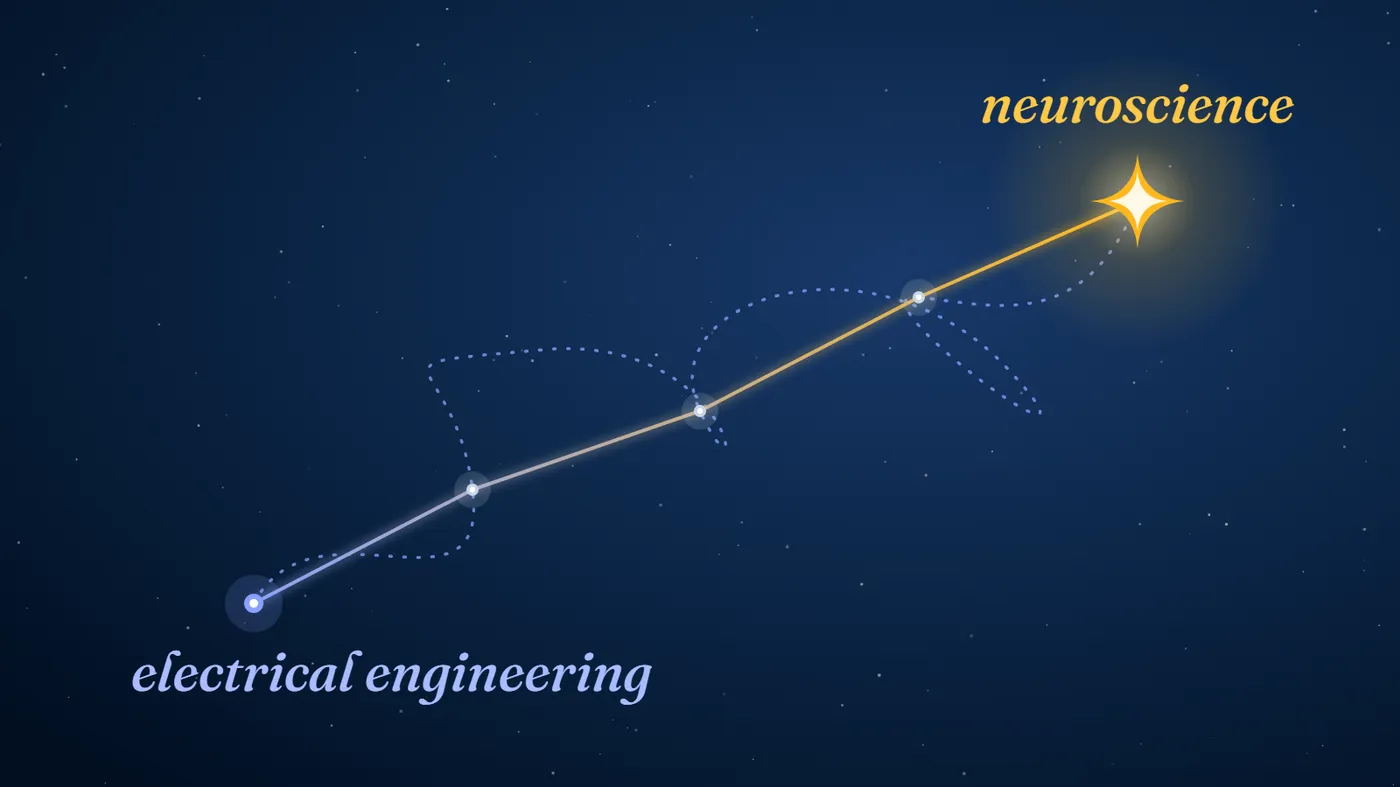
An applicant who moves from electrical engineering to neuroscience, for instance, need not disguise that transition as a perfectly planned journey. The more interesting question is whether experiences with control systems, computation, or artificial intelligence genuinely led the applicant towards new questions about the brain.
The dots do not need to have been connected from the beginning. They need to make sense in retrospect.
That is also where intellectual humility enters the picture. A consequential applicant does not need to portray every decision as brilliant or every initiative as successful. The ability to acknowledge a mistaken assumption, explain how evidence changed one’s thinking, and recognise the contributions of others can reveal a maturity that an uninterrupted success story cannot.
The objective is not to manufacture a flawless persona. It is to make your intellectual development legible.
From applicant to possibility
None of this means that one unusual project guarantees admission. Selective universities weigh academic preparation, the requirements of individual programs, institutional priorities, and many other factors. No single narrative can substitute for the foundations of a credible application.
But once you have established those foundations, consider a different question.
Do not ask only
What will this university give me?
Ask
- What you wish to investigate there
- Which questions you are prepared to pursue
- What perspectives or experiences you might bring to the academic community
Research the department. Understand its intellectual priorities and pulse of research focus areas. Identify the genuine connections between its work and your own emerging interests.
Then make the case.
The strongest application is not necessarily the one that makes its author appear extraordinary at every turn. It is the one that gives a reader a convincing reason to believe that the applicant’s next chapter follows meaningfully from the last and that something worthwhile might happen when the two meet.
At Blue Bear, we believe the task is not to turn students into better packaged versions of one another. It is to help them recognise, articulate, inspire, and develop what is distinctly their own.
So, before adding another certificate to your profile, pause.
Find your magic brick.
That is where a consequential application begins.
Watch the video
We talk through these ideas in Who is a Consequential College Applicant? on the Blue Bear Global YouTube channel.
Frequently asked questions
What if I don’t have a big project like the magic brick?
Most students don’t, and that’s fine. The magic brick isn’t about size. Look at things you have already done and ask what you noticed, what you tried and what changed because of you. A small effort explained honestly can tell a reader more than a long list of titles.
Should I start a new project just for my application?
Only if you would want to do it anyway. Projects started late, just to fill a gap, often read that way. It’s usually better to go deeper into something you already care about, even if it’s small.
Should I remove certificates and other activities from my resume?
No. They still show effort and interest. Just don’t expect them to tell your story for you. Choose the one or two experiences that show how you think, and explain those well.
How do I write about a project that didn’t work?
Say what you tried, what went wrong and what you changed afterwards. Being honest about what didn’t work can show more maturity than a story where everything went right. It shows how you think when things get hard.
Where does my magic brick belong: the resume, the essay or the recommendation?
It can appear in all three, in different ways. Your resume gives the facts, your statement of purpose or essay explains your thinking, and a teacher or mentor who saw the work can describe it in their letter. Make sure the three tell the same story.
Does this apply to master’s and PhD applications too?
Yes. The same question works at every level: what have you done that someone else couldn’t have done in quite the same way? For research degrees, the answer is often a question you pursued, a method you tried or a problem you kept working on.