Let’s try an experiment.
Open ChatGPT and enter:
“Write a compelling 1,000-word Statement of Purpose for an MS in Information Science at Cornell Tech. Make it unique, intellectually stimulating, and admission-worthy.”
Within seconds, you’ll probably have a document with a sophisticated opening, neatly arranged academic experiences, convincing career goals, and a paragraph about why Cornell Tech is the perfect university.
It might even sound brilliant.
But ask yourself one question.
If an admissions interviewer asks you why you made a particular argument in your SOP, can you defend it without asking ChatGPT for help?
If the answer is no, you have a problem.
Welcome to the most important distinction in graduate applications in 2026: the difference between using AI to improve your thinking and using AI instead of thinking.
1. AI can generate an argument. It cannot give you ownership of that argument.
Consider two applicants.
Applicant A
- Uses AI to construct an opening paragraph around an influential book on artificial intelligence
- The paragraph sounds sophisticated and contains an interesting disagreement with the author’s position
Applicant B
- Reads the same book
- Examines the author’s argument
- Identifies a disagreement
- Connects it to a personal experience or project
Both applicants might produce equally polished paragraphs.
But there is a fundamental difference.
Applicant A has borrowed an intellectual position. Applicant B has developed one.
This distinction matters because a Statement of Purpose is not merely a writing sample. It is an opportunity to demonstrate intellectual independence, critical thinking, and the ability to articulate your own perspective.
During a recent brainstorming session for a Cornell Tech applicant, I discussed a possible opening inspired by AI Snake Oil, by Sayash Kapoor and Arvind Narayanan.
The idea was to challenge an argument about AI rather than simply quote the authors.
But I also made one condition clear: if you use an intellectual hook, you must own it.
You must have read the material, understood the argument, formed your own position, and be prepared to defend that position.
Otherwise, the hook becomes intellectual decoration. I have the book on my shelf and I have personally read it to arrive at this status quo of criticising Arvind Narayanan and his dear student. So I stand firm on the ground supported by the hook I created.
2. Stop asking AI to summarise every research paper, article you are supposed to read or every podcast you are supposed to listen to
This is probably one of the most consequential mistakes applicants are making.
Universities increasingly provide access to conversations, lectures, podcasts, speaker series, and other resources that reveal their academic and institutional interests.
Students are encouraged to explore these resources.
What do some applicants do?
They feed the podcast transcript into AI and ask:
“Summarise the key insights and tell me what I should mention in my SOP.”
Convenient? Absolutely.
Effective? Not necessarily.
Let’s take Cornell Tech as an example.
During our brainstorming session, I recommended that the applicant personally explore the Good Code Podcast, Cornell Tech student podcasts, and the Bloomberg speaker series.
Why?
Because the purpose wasn’t merely to collect information about Cornell Tech.
It was to discover what its professors, students, and invited speakers were genuinely passionate about.
A formal research paper follows a prescribed structure. A university webpage communicates institutional information. But an extended conversation can reveal the questions someone keeps returning to, the problems they care about, and the ideas that excite them.
Those details can lead to something much more valuable than a generic university-fit paragraph.
They can lead to a moment of intellectual discovery.
I call this a moment of epiphany.
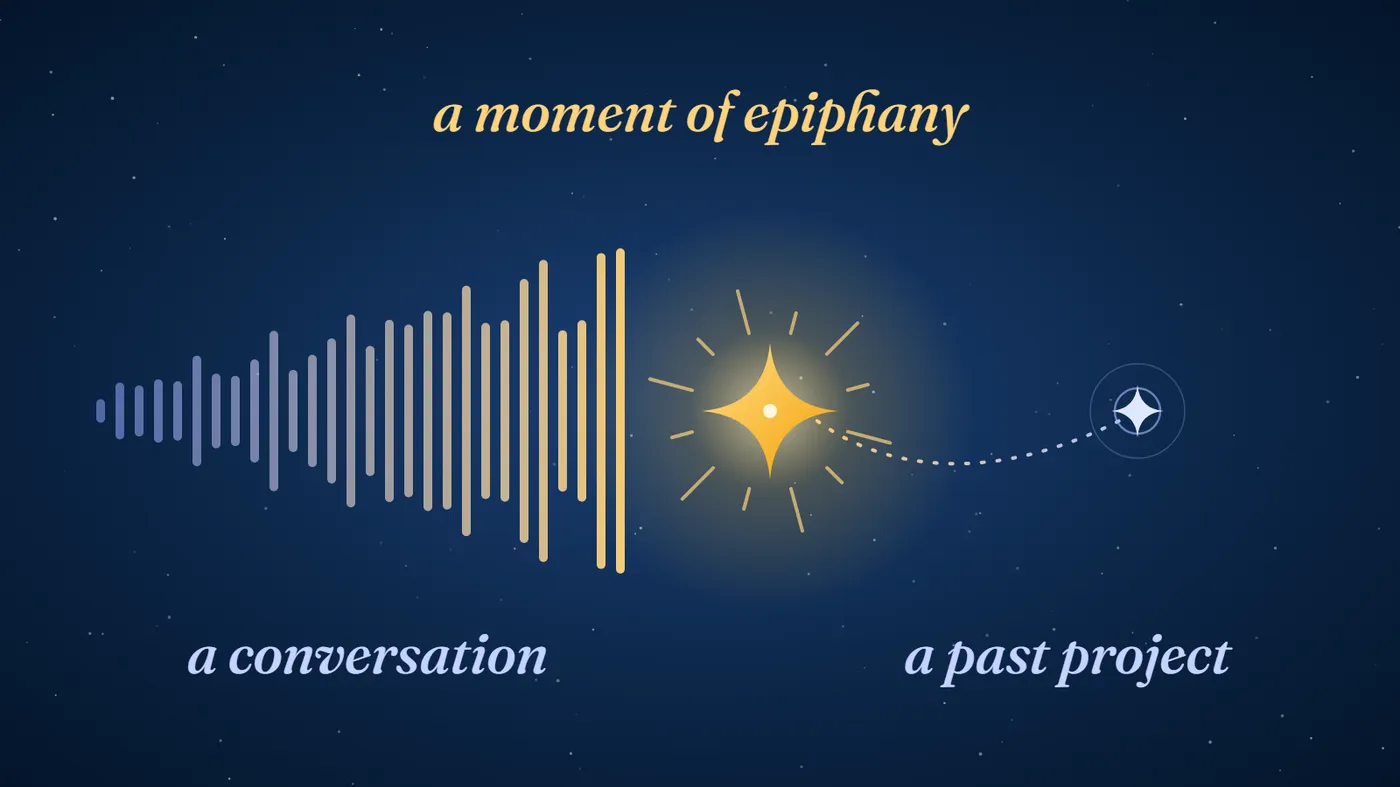
Imagine listening to a speaker discuss the intersection of technology, public infrastructure, and social impact. Something in that conversation connects with a project you completed two years ago.
Suddenly, you see that project differently.
You discover a larger problem you hadn’t considered before.
That discovery could become the foundation of an exceptional SOP paragraph.
An AI-generated podcast summary might tell you what the speaker said.
But it cannot guarantee that you experience the same intellectual connection.
3. Don’t outsource your reading list to an algorithm
Here is another unconventional suggestion.
Read something because you genuinely want to understand it.
Not because you think it will look impressive in your SOP.
During our discussion, I recommended exploring foundational Turing Award lectures, including the work of Edsger W. Dijkstra.
Why these lectures?
Because foundational lectures can expose applicants to the evolution of an entire discipline, its philosophical foundations, and the questions that shaped its development.
You don’t need to turn every lecture into an SOP paragraph.
You don’t even need to extract a ready-made takeaway from every reading session.
Sometimes, the learning happens subconsciously.
A concept you encounter today might influence the way you interpret a completely different problem next week.
There is another interesting principle here.
The more you read, the better you become at processing information, identifying patterns, connections, connecting the dots, and expressing complex ideas concisely.
Brevity is not necessarily a product of writing less.
It can be the outcome of thinking more, reading and processing what you read! That becomes analysis. In short, you are a data processor yourself rivaling an AI tool itself!
And if a particular lecture or podcast is too dry, too difficult, or simply doesn’t interest you, move on. Curiosity cannot be manufactured by forcing yourself through an arbitrary reading list.
Use AI to discover resources if necessary. Don’t let it replace the experience of engaging with them.
4. Don’t let AI turn your career into a perfectly linear story
This is particularly important for applicants with unconventional backgrounds.
Suppose your resume includes:
- Product management.
- Marketing.
- IoT software engineering.
- Website development.
- Data science.
- Artificial intelligence and automation.
You might be tempted to ask AI:
“Connect these experiences and create a compelling career narrative for my MS application.”
The result could be a beautifully constructed story about your lifelong passion for interdisciplinary technology.
But is that actually your story?
In our Cornell Tech brainstorming session, the applicant had explored several technical and business disciplines.
Initially, the diversity of experiences appeared to be a challenge.
The more interesting explanation, however, was that the applicant had deliberately explored different domains to understand where technology, business, and mathematics intersected.
Each experience had contributed to a better understanding of what they enjoyed, what they didn’t, and what they wanted to pursue next.
That is a much more interesting narrative than pretending to have followed a perfectly planned career trajectory from the beginning.
Don’t ask AI to manufacture coherence. Reflect on your experiences until you discover the coherence that already exists.
5. Don’t ask AI to tell you why a university is perfect for you
This is where generic SOPs become particularly obvious.
You ask an AI tool to research a university, and it returns a familiar list:
- World class faculty.
- Innovative curriculum.
- Cutting edge research.
- Diverse student community.
- Excellent industry connections.
You could replace the university’s name with five other institutions and the paragraph would still work.
That is precisely the problem.
A university specific SOP needs more than information about the university. It needs an interpretation of that information. And what it means to you!
During the Cornell Tech discussion, we examined themes including Public Interest Technology, interdisciplinary concentrations, Product Studio, Startup Studio, and PiTech Impact Studio.
The interesting observation was that these elements collectively suggested a learning environment centred on interdisciplinary collaboration, product development, and solving real-world problems.
That led us to a much more consequential question:
What kind of applicant would thrive in such an environment?
And, more importantly:
What would this applicant contribute to it?
This is the level of thinking you should aspire to.
AI can help you locate information. It can organise programme descriptions and compare institutional priorities.
But you must evaluate what those priorities mean for your own academic interests.
Don’t confuse researching a university with understanding it.
6. Don’t manufacture an intellectual hook just because AI says it sounds impressive
A sophisticated opening is not necessarily an effective opening.
A quotation from a Nobel laureate, a reference to a philosophical concept, or a disagreement with a famous researcher can all become excellent hooks.
They can also become embarrassing distractions.
Imagine opening an SOP with a reference to Ray Kurzweil’s ideas about immortality and connecting them to artificial intelligence and data science.
Now, that is an intriguing intellectual direction!
But the connection must be natural.
Why does immortality interest you? What does it have to do with your academic journey? How did it influence your understanding of technology and AI itself?
If you cannot answer those questions, the reference is probably ornamental.
Creative connections can make an SOP memorable, but they must emerge from genuine intellectual engagement.
The same applies to AI generated hooks.
Don’t use a sentence simply because it sounds profound.
Use it because you have something meaningful to say.
7. So, what SHOULD you use AI for when writing your SOP?
Let’s be clear.
I’m not suggesting that applicants abandon AI.
That would be rather absurd in 2026.
AI can be an extremely useful intellectual assistant when used appropriately.
Here is how I would divide the responsibilities.
| Task | Your role | AI’s role |
|---|---|---|
| Discovering your interests | Reflect and explore | Suggest areas to investigate |
| Reading and research | Engage with original sources | Organise references and explain difficult concepts |
| Identifying career pivots | Select meaningful experiences | Help compare and categorise them |
| Developing your argument | Form your own position | Challenge assumptions and identify gaps |
| Structuring the SOP | Decide the narrative | Suggest alternative structures |
| Writing the first draft | Supply the substance and authentic voice | Assist with organisation only if needed |
| Editing and refinement | Approve every substantive change | Improve clarity, grammar, and readability |
| University alignment | Interpret institutional priorities | Help cross check your research |
The distinction is straightforward.
AI should make you a better thinker and communicator, not a more dependent writer.
8. The five-question AI test before submitting your SOP
Before submitting your application, ask yourself:
0 of 5
If you cannot confidently answer these five questions, revisit the document.
Frequently asked questions: AI and SOP writing in 2026
Can universities detect AI-generated SOPs?
AI-detection tools are not definitive proof of authorship. Detection results can be unreliable, and different institutions have different application and AI-use policies. Applicants should follow each institution’s current rules and ensure their submissions genuinely reflect their own thinking and experiences.
Is it wrong to use ChatGPT to write an SOP?
Using ChatGPT for brainstorming, feedback, outlining, or language refinement can be helpful. However, outsourcing the substance of your personal narrative, research, and intellectual arguments creates a serious authenticity problem. Always check the university’s AI-use policy.
Should I use AI to summarise university podcasts?
AI summaries can help you navigate long recordings, but they should not replace personally listening to relevant material. Your own observations and unexpected discoveries can produce much stronger university-fit arguments.
Can AI help me find an SOP opening hook?
Yes. It can suggest possibilities based on your experiences and interests. However, the final hook must reflect an idea you genuinely understand and can defend.
What is the biggest mistake students make when using AI for SOPs?
Confusing polished language with meaningful content. An SOP can be grammatically flawless and still lack personal ownership, critical thinking, and a coherent academic direction.
Will an AI-edited SOP sound artificial?
Not necessarily. AI-assisted editing can improve readability without compromising authenticity if the applicant retains control over the substance, voice, and final decisions.
The final word: Don’t outsource the person behind the application
There is an interesting paradox in the age of artificial intelligence.
As technology becomes increasingly capable of generating sophisticated content, the value of distinctly human capabilities becomes more apparent.
Curiosity. Judgement. Independent thinking. Intellectual courage. The ability to connect seemingly unrelated ideas.
These are not decorative qualities you sprinkle into an SOP.
They are the qualities that should shape the document in the first place.
Your university application is not a competition to produce the most sophisticated collection of sentences.
It is an opportunity to demonstrate how you think, what you care about, what you have learned, and what you intend to do with that knowledge.
Use AI. Experiment with it. Challenge it. Ask it some difficult questions.
But don’t let it think on your behalf.
Because an admissions committee isn’t admitting your AI tool. It’s admitting you.
Big dreams. Bigger world.
Blue Bear Global
Helping ambitious students think deeper, write better, and build meaningful global futures.