

You have shortlisted your universities. You have compared rankings, explored courses, read alumni testimonials, and perhaps even bookmarked a few professors whose work sounds fascinating.
Now comes the inevitable question: Why do you want to study here?
Your answer might sound something like this:
“I am drawn to your university’s interdisciplinary approach and commitment to innovation.”
Or perhaps:
“I hope to contribute to your vibrant academic community while learning from world-class faculty.”
Nothing wrong with these statements. They are perfectly reasonable. They are also remarkably easy for thousands of other applicants to write.
And that is precisely the problem.
Most students research universities. Far fewer investigate what those universities are actually trying to accomplish.
There is a difference between knowing what an institution says about itself and understanding what it is actively working towards.
A university’s mission statement
Tells you what it aspires to become.
Its strategic plan
Reveals what it intends to prioritise.
Its research investments, funded projects, institutional initiatives, and faculty recruitment
Offer clues about where those ambitions are turning into action.
For students applying to universities abroad, understanding this distinction can transform how they research institutions, evaluate academic fit, and communicate their ambitions.
Welcome to a more strategic way of researching universities!
1. Your dream university isn’t just a destination. It has a direction.
Imagine two students applying to the same computer science programme. Both have excellent academic records. Both have explored the university website. Both are genuinely interested in technology.
Applicant A
- Writes about the university’s global reputation, renowned faculty, interdisciplinary curriculum, and excellent research facilities
Applicant B
Investigates further
- They discover that the university has launched an initiative focused on climate resilience
- They explore the departments involved and find a research group developing environmental sensing technologies
- They then connect this work to an independent drone project they built to study marine pollution
Which applicant has the more convincing explanation for choosing that university?
Applicant B has done something more valuable than collecting impressive university facts. They have identified a specific connection between their own experience and the institution’s academic direction.
This doesn’t automatically make Applicant B a stronger candidate overall. Admission decisions depend on many factors, including academic preparation, programme fit, and the quality of the application.
But Applicant B has a more meaningful starting point for explaining why that university makes sense for their next stage of development.
And this principle extends far beyond computer science.
Undergraduate applicants
Which academic initiatives, interdisciplinary opportunities, or research experiences connect with your developing interests?
MS applicants
Which research groups, laboratories, or technical projects complement your existing skills?
MBA applicants
How does the business school approach entrepreneurship, healthcare innovation, leadership, or economic development?
PhD applicants
Which faculty members are pursuing questions you genuinely want to investigate, and how does your preparation connect with their work?
The level of research changes with the degree. The underlying principle does not.
Don’t simply ask
“Why is this university impressive?”
Ask
“Why might this university be the right environment for the work I want to do?”
2. Follow the money – but understand what it tells you
Here is a useful starting point for researching a university: follow its funding.
Universities receive resources from governments, research councils, private foundations, industry partners, philanthropic donors, and other sources. These resources support everything from laboratories and equipment to research teams, interdisciplinary programmes, and long-term projects.
When a university announces a major investment in artificial intelligence, renewable energy, public health, advanced manufacturing, or another research area, it gives you a reason to investigate further.
But don’t stop at the headline.
A multimillion-dollar research award may look impressive on a university’s website. The more important question is what that money will actually enable researchers to do.
Suppose a university announces a substantial investment in artificial intelligence.
Instead of immediately adding “AI research” to your statement of purpose, investigate:
Notice the progression. You move from a headline to an actual research question.
A large grant may have little relevance to your application if its research has nothing to do with your interests. A smaller project, however, could be highly relevant if it addresses a question you have already begun exploring.
The amount of funding isn’t the insight. Understanding what the funding makes possible is.
3. Read a university at three levels
How do you turn a university’s broad ambitions into something useful for your application?
Think of your research as a journey through three interconnected levels.
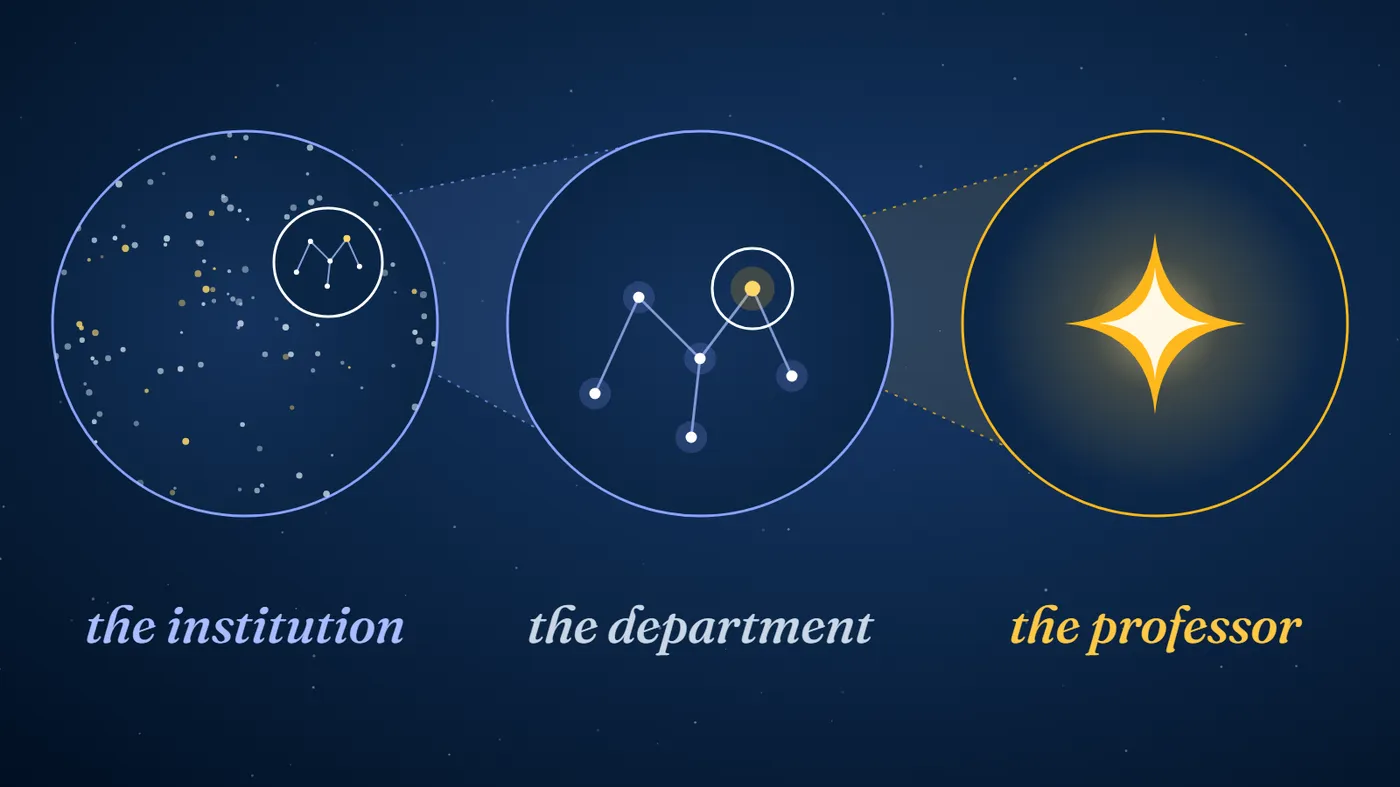
Level 1: The institution – understand the big picture
Start with the university itself.
Look beyond its homepage and promotional material. Explore its:
- Strategic plan and research strategy
- Annual reports and official research announcements
- Major institutional initiatives
- Budget and investment announcements
- Research partnerships and public policy initiatives
- Faculty recruitment and expansion plans
Look for themes that appear repeatedly.
Is the university expanding interdisciplinary research? Investing in sustainability? Strengthening industry partnerships? Developing healthcare technologies? Building capacity in artificial intelligence?
Repeated themes supported by concrete initiatives can tell you more than an isolated sentence in a mission statement.
Distinguish between aspiration and action.
Aspiration
- A university may express a long-term commitment to sustainability, for instance
Action
- A funded research centre
- An implementation plan
- A new interdisciplinary programme
More specific evidence of how that commitment is being pursued.
At this stage, you are trying to understand the institution’s overall direction.
Level 2: The department – discover where the work happens
Once you understand the bigger picture, narrow your focus.
A university might prioritise artificial intelligence across the institution. But one department may focus on robotics, another on medical imaging, and a third on energy-efficient computing.
These are different research directions, even though they share a broad theme.
Explore departmental research pages, laboratory websites, recent project announcements, seminar descriptions, collaboration news, and faculty profiles.
For an MS applicant, this could mean identifying a laboratory whose work complements the technical skills they have developed.
For a PhD applicant, it means understanding the research questions a potential supervisor is pursuing and the methods their group uses.
For an undergraduate applicant, it may reveal interdisciplinary courses, experiential projects, or research opportunities – provided those opportunities are genuinely available to undergraduates.
The objective is to move from a broad institutional ambition to an academic area you can discuss intelligently.
Level 3: The individual professor – understand the person behind the research
This is where your research can become particularly interesting.
Once you identify a faculty member whose work connects with your interests, don’t stop after reading their profile or the abstract of their latest paper.
Read their recent publications. Explore their ongoing projects. Look for recorded lectures, conference presentations, interviews, and research podcasts.
Why?
Because formal academic writing and public conversations can reveal different aspects of a researcher’s thinking.
A paper may explain what they investigated and what they found. A lecture or interview may reveal which unresolved problems concern them, what limitations they see in existing approaches, or which future directions excite them.
The goal isn’t to imitate the professor’s language or flatter them in your application.
It is to develop an informed perspective of your own.
A student who has genuinely engaged with a research problem is better positioned to explain why it matters than someone who has simply copied a laboratory description from a website.
4. Where should you look? Build your research trail
Institutional priorities rarely appear in one convenient document. You often have to piece together the picture from multiple sources.
Here is a practical research trail you can follow.
- Step 1 Start with official university sources
- Step 2 Explore research funding databases
- Step 3 Read the project descriptions
- Step 4 Listen to researchers speak
- Step 5 Check the dates
Start with official university sources
Read the strategic plan, research office announcements, departmental pages, laboratory websites, annual reports, and current programme requirements.
Explore research funding databases
For US research, the National Science Foundation’s award search can help you identify funded projects, principal investigators, research objectives, and project periods. Depending on your discipline, you may also need to explore other government agencies, research councils, foundations, or industry-sponsored programmes.
Read the project descriptions
If a public project abstract, proposal, or progress report is available, examine the research question and intended outcomes. A project title and funding amount rarely tell you the whole story.
Listen to researchers speak
Recorded seminars, conference presentations, interviews, and research podcasts can help you understand how faculty members discuss their work beyond formal publication language.
Check the dates
A grant announced several years ago may have concluded. A professor may have moved institutions. A research centre may have changed direction.
Verify the current status of anything you plan to mention in an application or email.
5. Find the intersection between the university’s priorities and your own trajectory
This is the step that turns research into application strategy.

Let’s return to our computer science student who built a drone-based project exploring marine pollution.
They discover that their shortlisted university is investing in environmental research. They also find a professor working on computer vision for environmental monitoring.
At first glance, the connection seems promising.
But simply writing, “I share your university’s passion for sustainability and hope to work with Professor X,” doesn’t tell the admissions committee very much.
The student needs to go deeper.
First, understand your own work
What problem did your drone project address? What did you personally build, test, or investigate? Which technical challenges did you encounter? What did the experience teach you?
Second, understand the university’s work
What is the professor actually investigating? Which methods do they use? What makes their approach relevant to the problem you care about?
Third, identify the genuine connection
Perhaps the professor studies computer vision for environmental monitoring rather than marine pollution specifically.
That distinction matters. The student should not pretend that the professor is working on the exact same problem.
Instead, they might recognise a connection through the underlying methods: image analysis, remote sensing, or automated environmental monitoring.
Finally, identify the next step
What do you want to learn? Which capabilities do you hope to develop? What question would you like to explore further?
The resulting application can demonstrate a credible relationship between past experience, present interests, and future ambitions.
It doesn’t need to claim that the student’s existing project is research-grade or that a professor would automatically want to supervise it.
It needs to show that the student has thought seriously about the connection.
The objective is not to manufacture a match. It is to discover whether a meaningful match exists.
That is a much more useful foundation for an application.
6. How does this research change depending on your degree?
The same approach can serve different purposes depending on what you intend to study.
If you’re applying for an undergraduate degree
You may not have an extensive research portfolio, and that’s perfectly fine.
Focus on your intellectual curiosity, independent projects, academic interests, and the kinds of learning experiences you want to pursue.
Institutional priorities can help you understand why a university’s academic environment appeals to you.
For example, a student interested in public health and computer science might investigate an interdisciplinary initiative that brings together data science, healthcare, and social research.
The important thing is to explain what you hope to learn and why the opportunity matters to you.
Your essay should still centre your experiences and potential – not read like a university strategy report.
If you’re applying for an MS
Your research should connect your existing preparation with the expertise you want to develop.
Investigate relevant specialisations, laboratories, research groups, and faculty projects.
If you are interested in research, identify a specific problem or method that complements your technical background. If you are pursuing a primarily taught programme, investigate its curriculum, practical learning opportunities, industry connections, and relevant academic resources.
Make sure the opportunities you mention are genuinely available within your programme.
If you’re applying for an MBA
Institutional research is not limited to scientific laboratories and research grants.
Explore the business school’s approach to entrepreneurship, experiential learning, leadership development, industry partnerships, and the economic ecosystem surrounding the institution.
Suppose your long-term goal is to build a healthcare technology venture. Understanding how a school connects entrepreneurship with healthcare innovation may help you identify relevant courses, venture programmes, industry networks, and experiential opportunities.
The question becomes: how will this specific environment help you solve the business problems you care about?
If you’re applying for a PhD
This is where the research becomes especially important.
Investigate prospective supervisors’ publications, ongoing projects, methods, research questions, and publicly available funding information.
Look for the questions that connect with your previous research and the directions you might pursue next.
Also verify the programme’s admissions process, supervision model, funding structure, and faculty availability. A professor receiving a research award does not necessarily mean they have an open doctoral position.
Your objective is to demonstrate research alignment, intellectual readiness, and a credible reason for wanting to work within that academic environment.
7. A word of caution: don’t mistake a research grant for an open door
There is one mistake worth avoiding.
You discover that a professor has received a major research grant. You conclude that they must be looking for students. You send an email asking to join the project.
The opposite is also possible. A professor without a recently announced grant may still be interested in a suitable applicant or have access to other resources.
Similarly, an early-career faculty member establishing a research programme may be worth investigating, but their career stage alone cannot tell you whether they are recruiting.
Investigate the person, the project, and the programme. Don’t reduce a researcher to their funding history or career stage.
And remember: institutional research is one component of a strong application, not a substitute for academic preparation, programme eligibility, or a compelling explanation of your goals.
8. Your practical university research worksheet
Before writing your next statement of purpose, supplemental essay, or PhD outreach email, create a simple evidence sheet.
You don’t need an elaborate spreadsheet. Start with these seven questions.
0 of 7
Keep track of your sources and any limitations. If the connection is speculative, acknowledge that rather than presenting it as an established collaboration or opportunity.
Then adapt your findings to the purpose.
In an undergraduate essay
The research may help you explain why a particular learning environment suits your interests.
In an MS application
It may clarify your intended specialisation and the skills you hope to develop.
In an MBA essay
It may help you connect the school’s opportunities with the business challenges you want to address.
In a PhD email
It may help you articulate a research question and explain why a particular professor’s work is relevant to your trajectory.
In every case, the institution-specific detail should support your story—not replace it.
The real advantage: learning to see what others overlook
Institutional-priorities research is not an admissions trick. It is a way of making better decisions.
It can help you distinguish between a university that looks impressive on paper and one that genuinely fits your interests. It can help you discover research worth pursuing, ask better questions, and approach faculty with a more informed understanding of their work.
It may even reveal that a university you initially considered an ideal match isn’t the right environment for you after all.
That is useful information, too.
The strongest applications are not necessarily those that mention the largest grants, the most celebrated professors, or the most ambitious institutional initiatives.
They are the ones that establish a thoughtful, evidence-based connection between the applicant’s experiences, the institution’s academic environment, and the work the applicant hopes to pursue.
So, before you write another paragraph about a university’s reputation, look beneath that reputation.
Read its strategy. Investigate its research. Understand its investments. Listen to the people doing the work.
Then ask yourself the question that matters most:
Where does this university’s direction intersect with the work I want to do – and what can I bring to that intersection?
That is where university research becomes application strategy.
And that is where a more consequential application begins.
Frequently asked questions
Where can I find a university’s strategic plan?
Search for the university’s name plus “strategic plan” or “research strategy”. It’s usually on the president’s or vice-chancellor’s pages, or on the research office’s site. If you can’t find one, the latest annual report and the research news page are good places to start.
How many universities should I research this deeply?
You don’t need to do this for every name on your list. A quick look is enough at first. Save the deep research for the universities you are seriously applying to, especially the ones that ask why you want to study there.
What if I’m not applying to the US?
Most places have something similar to the NSF search. In the UK, try Gateway to Research. For EU-funded projects, try CORDIS. Canada has the NSERC awards database and Australia has the ARC Data Portal. For health research in the US, look at NIH RePORTER.
Should I mention the size of a grant in my essay?
Usually not. The amount tells a reader very little about you. Talk about the question the research is trying to answer and why it connects with your own work. If you do name a project, check that it’s still running first.
I’m applying as an undergraduate. What if the research goes over my head?
That’s normal, and nobody expects you to follow every detail. Start with the plain versions, like university news stories, project summaries and recorded talks. Focus on the problem the researchers are trying to solve. In your essay, only write about what you really understand.
What if I can’t find a connection at a university I love?
Look one level down first. A single department, lab or course may fit even when the big institutional themes don’t. If you still can’t find a real link, think again about why that university is on your list. It’s better to find that out now than after you’ve applied.
Explore the institution. Understand the mission. Find your point of contribution.